10 Things You Didn’t Know About Truffles (But Everyone Should)
The truth about truffles might surprise you
1. Truffles aren’t mushrooms—they’re a rare underground fungus with a mind of their own
Most people assume truffles are just fancy mushrooms, but the truth is way more interesting. Truffles grow beneath the soil, attached to the roots of specific trees like oak and hazelnut. They can’t be farmed easily, they refuse to grow where conditions aren’t perfect, and they rely on animals to spread their spores.
This is exactly why they’re so rare, so aromatic, and so expensive. Nature makes them difficult on purpose.
2. They’re one of the most expensive foods in the world — and here’s why
Truffles aren’t just a luxury ingredient; they’re one of the priciest foods on the planet. Some rare white truffles have sold for tens of thousands of dollars, and even everyday varieties can cost more per kilo than gold.
But the price isn’t just hype. Truffles are expensive because nature makes them incredibly difficult to find and nearly impossible to farm. They grow underground, only in specific climates, only near certain trees, and only for a short season each year. Add in the fact that trained dogs are needed to locate them, and you get a food that’s as rare as it is irresistible.
This combination of scarcity, aroma, and mystique is exactly why chefs and food lovers treat truffles like edible treasure.
3.Truffle aroma is so powerful it can change the flavor of nearby foods
One of the wildest things about truffles is their aroma strength. They release such intense natural compounds that they can actually infuse flavor into foods around them—without ever touching them.
Chefs often store truffles in sealed containers with eggs, rice, or butter because those ingredients absorb the aroma like a sponge. The result is a naturally truffle‑infused ingredient that tastes luxurious before the truffle even hits the pan.
This is also why truffles are so prized: their scent isn’t just strong, it’s transformative.
4. Dogs are now used more than pigs to hunt truffles — here’s the surprising reason
For centuries, pigs were the traditional truffle hunters. They have an incredible natural ability to sniff out truffles buried deep underground. But there was one big problem: pigs love to eat truffles just as much as humans do.
Dogs, on the other hand, can be trained to detect the same powerful aroma without trying to devour the prize. They’re easier to handle, gentler on the forest floor, and far less likely to run off with a €3,000 truffle in their mouth.
Today, most truffle hunters rely on specially trained dogs—often Lagotto Romagnolos, a breed famous for its truffle‑finding talent. These dogs turn the hunt into a partnership rather than a tug‑of‑war.
5. Truffles grow only in very specific climates — and that’s what makes them so rare
Truffles aren’t just picky—they’re extremely picky. They only grow in regions with the perfect mix of soil type, rainfall, temperature, and tree species. They need alkaline soil, mild winters, warm summers, and just the right amount of moisture.
This is why true truffle hotspots are limited to places like Italy, France, Spain, and a few carefully cultivated regions around the world. Even then, nature decides the yield each year. Some seasons are generous, others produce almost nothing.
That climate sensitivity is a huge part of what makes truffles so valuable. You can’t mass‑produce them. You can’t force them. You can only hope nature cooperates.
6. Some truffle scents come from natural compounds also found in… surprising places
One of the reasons truffles have such a legendary aroma is because they contain powerful natural compounds—some of which show up in places you’d never expect.
For example, certain white truffles produce a compound that’s also found in the scent glands of animals. It’s completely natural, totally safe, and part of what gives truffles their deep, earthy, almost intoxicating smell.
This unusual overlap is exactly why truffles have such a primal, unforgettable aroma. It’s also why humans react so strongly to them—our brains are wired to notice these compounds, even if we don’t consciously understand why.
Truffles smell like luxury, but their chemistry is wild.
7. Truffles have natural aphrodisiac associations — and it’s not just legend
For centuries, truffles have been linked to romance and desire. Ancient cultures believed their deep, earthy aroma had a stimulating effect, and even today, chefs describe the scent as sensual and intoxicating.
Part of this reputation comes from chemistry: truffles contain natural compounds that are also found in human pheromones. While they won’t magically spark passion, their aroma does trigger parts of the brain associated with attraction and pleasure.
8. Truffle oil is often not made from real truffles — here’s the truth behind the bottle
Most people are shocked to learn that the “truffle oil” used in restaurants and sold in stores usually contains no real truffles at all. Instead, it’s typically made from a neutral oil infused with a synthetic aroma compound designed to mimic the scent of real truffles.
That’s why truffle oil has such a strong, almost overpowering smell—it’s engineered to be intense. Real truffles, by contrast, have a complex, delicate aroma that changes with season, region, and freshness.
This doesn’t mean truffle oil is “bad,” but it is different. It’s a flavoring inspired by truffles, not a product of them. And once people learn this, they never look at that bottle the same way again.
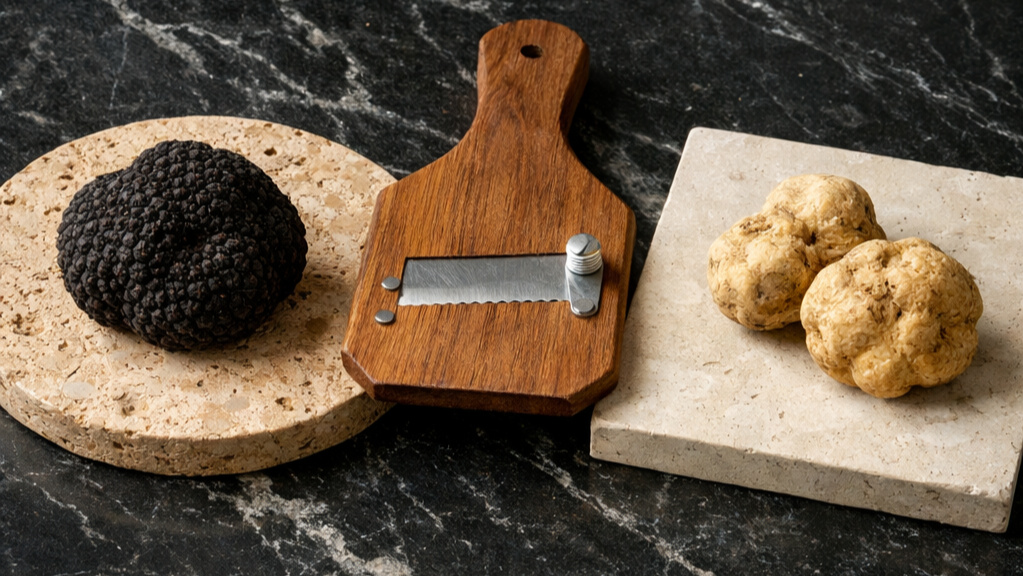
9. White and black truffles are completely different species — and their flavors couldn’t be more opposite
White and black truffles may look similar at first glance, but they’re actually entirely different species with their own aromas, seasons, and culinary personalities.
White truffles (like the famous Alba truffle) are prized for their intense, almost garlicky aroma and are always eaten raw, shaved over dishes at the last moment. Their scent is delicate, complex, and impossible to cook without losing their magic.
Black truffles, on the other hand, have a deeper, earthier, more chocolate‑like aroma. They love heat—cooking actually enhances their flavor—so chefs use them in sauces, pastas, and warm dishes where their aroma can bloom.
Different species, different flavors, different uses… but both pure luxury.
10.Truffles have been prized since ancient times — a luxury with thousands of years of history
Long before truffles became a modern gourmet obsession, ancient civilizations were already treating them like culinary treasure. The Greeks believed truffles were created when lightning struck the earth. The Romans considered them a gift from the gods and used them in lavish feasts reserved for the elite.
Throughout history, truffles were associated with wealth, power, and even magic. Medieval nobles paid extraordinary prices for them, Renaissance chefs guarded truffle recipes like secrets, and European royalty served them as the centerpiece of extravagant banquets.
What’s remarkable is that after thousands of years, nothing has changed—truffles are still one of the world’s most mysterious and sought‑after delicacies. Their rarity, aroma, and almost mythical reputation have kept them at the top of the culinary world since ancient times.
Prime Truffle is a U.S.-based gourmet truffle online store specializing in luxury gift boxes, premium Italian truffle sauces, creams, oils, and gourmet truffle products.